Slot 01 · Value blog
Blog copy, product-free end to end. Publishes at /blogs/noticias/. Brief: hub slot 01.
Title options
Five candidates. The H1 is unset until one is chosen; the article below runs without a title.
| # | Title | Angle | Why it works |
|---|---|---|---|
| 1 | Why Is American Food So Processed? The 80% Number the Industry Admitted | SEO | Front-loads the query people actually type and keeps the number in the SERP. Longest of the five |
| 2 | Washington Doubled Your Protein Target and Never Told You | Political | An institution moved a number quietly. No ideology, so it works across the aisle, which matters on a list this size |
| 3 | They Paid Harvard to Blame Fat. Then He Wrote Washington's Rules. | Conspiracy | Every clause is in JAMA Internal Medicine. "He" opens the gap without naming him, and keeps the continuity of the person, which is the actual finding. The only conspiracy framing here that is fully defensible |
| 4 | Nine of the Twenty Experts Behind Your Diet Advice Had Industry Ties | Institutional | A count, no accusation needed. The one fact that proves 1967 is not history. Ranks for dietary guidelines conflict of interest |
| 5 | You Eat More Added Fat Than a Big Mac Every Day. You Never Ordered One. | Concrete | Most shareable. Named brand does the search work, the arithmetic is checkable, and the second sentence is the thesis in four words |
The article
Eighty percent of the food supply. That is the industry's own number, in a letter to the FDA. How the protein left your morning breakfast, who got paid to put it there, and what is still standing.

Why Is American Food So Processed? The "80% Number" the Industry Just Admitted
In 2024 the FDA moved to reclassify NMN as a drug. We filed alongside the NPA, we published every update, and we gave this list every tool to push back. It worked.
This one is bigger, and it was not fought in a courtroom. It was settled in your kitchen, slowly, over fifty years. Last month the people who did it put a number on it.
This is what they admitted, who got paid to arrange it, where it lands on you, and the one thing in your morning they never managed to touch.
What they just admitted
On August 10, the first federal definition of "ultra-processed food" went to the White House budget office for final review. After decades of the phrase meaning whatever anyone wanted it to mean, it was about to mean something legally.
The food industry's own trade association wrote in to object. Their letter says the definition "captures 80 percent of the nation's food supply" and is therefore "fundamentally flawed."
Read that again.
By their own maths, nearly 80% of the American food supply would count as ultra-processed.
Nobody made them say that. They volunteered it, in a letter arguing they should not be counted.

The belief they sold you
You have been taught your whole life that falling behind in the morning is a discipline problem.
You slept through the alarm, you grabbed something on the way out, and if you are flattened by ten that is on you. So you buy the bar with the protein printed on the front, and for about a week it feels handled.
Notice how the story is always arranged. When it goes wrong, the variable is you. Your willpower, your planning, your commitment. Never the thing in the wrapper, which is described in the language of health right up until the moment it fails you, at which point it quietly becomes your fault.
It was never your discipline. The plate was changed underneath you, slowly enough that nobody had to announce it.
If you have been losing this fight for twenty years, that is not your failure. It was arranged. Let me show you how.

The proof, in the system's own words
You do not have to take my word for any of this. The people who set the rules have been writing it down the whole time.
- 57.9% of the calories Americans eat now come from ultra-processed food (Martínez Steele et al., BMJ Open 2016, NHANES 2009–10). Look at your own week: of every ten meals you ate, closer to six of them were assembled in a plant by people optimising for shelf life and cost, not for you
- Nearly nine in every ten grams of added sugar arrives inside that same food (same survey). You are not failing to resist the sugar bowl. The sugar was already in the box before you opened it
- The federal protein target sat at 56 grams per 2,000 calories for decades. It shaped the labels, the school lunch, the cereal box that called itself part of a complete breakfast
- On January 7 of this year it was raised to 84–112 grams. Roughly double, overnight (Dietary Guidelines for Americans 2025–2030). Whatever you ate this morning, the target it was built to meet moved while you slept, and nobody told you. That is per 2,000 calories. A 200-pound man lands at roughly 105 to 140.
- The same document told Americans, for the first time, to limit highly processed food
No correction went out. Nobody wrote to the people who had spent thirty years building their mornings around the old number.
So the official position now agrees with both halves of this article. It simply never mentioned it to you.

They Paid Harvard to Blame Fat. Then He Wrote Washington's Rules.
In 1967, three Harvard nutrition researchers published a review in the New England Journal of Medicine. It examined what causes heart disease, largely cleared sugar, and pointed at dietary fat. That review shaped how a generation of doctors, journalists and mothers thought about breakfast.
In 2016, researchers at the University of California went through the sugar industry's own internal correspondence and published what they found in JAMA Internal Medicine. The 1967 review had been commissioned and paid for by the Sugar Research Foundation, a sugar industry trade group, which set the objective before a single word was written.
One of the paid Harvard researchers was D. Mark Hegsted.
Ten years later he became the principal scientific adviser to the Senate committee that produced the 1977 Dietary Goals for the United States, the document that put grains at the centre of the American plate. He then went on to largely write the first federal Dietary Guidelines for Americans in 1980.
The man the sugar industry paid to point at fat helped write the rules that told the country to eat less of it.
That is not a rumour, an interpretation or a podcast. It is a peer-reviewed reconstruction built from the industry's own filing cabinet, and it has been public since 2016.

You Eat More Added Fat Than a Big Mac Every Day.
Once you know the rules were purchased, the rest stops looking like incompetence and starts looking like arithmetic.
- Grains and fats supply the cheapest energy of any food group. Protein tracked the highest price (Drewnowski, AJCN 2010)
- Vegetable oil went from 0.7 kg per person per year in 1909 to 14.7 by 1999 (Blasbalg et al., AJCN 2011). Work that out and it is about 40 grams a day. A whole Big Mac contains 34 grams of fat. You take on more added fat from vegetable oil alone, every day, than there is in an entire Big Mac, and you never ordered one. Your great-grandfather's whole year came to about half a bottle. Yours comes to eleven
That is the mechanism. Protein is the most expensive thing in the box, so it went first, and the cheapest calories on earth were poured into the space it left.
The second half is the part nobody bills for: the story wrapped around the cheaper box. Whole grain. Fortified. Heart healthy. Every one of those phrases does the same job, which is to make a cost decision sound like a nutrition decision.
That is not an accident. That is a margin.

None of this is only history. Nine of the Twenty Experts Behind Your Diet Advice Had Industry Ties
It would be comfortable to file 1967 under things that used to happen. The current numbers do not allow it.
- 9 of the 20 experts on the committee advising the latest Dietary Guidelines had financial or other ties to food, pharmaceutical or grocery companies in the preceding five years. Four more were found to have possible conflicts(U.S. Right to Know, "Full Disclosure: Assessing Conflicts of Interest of the 2025 Dietary Guidelines Advisory Committee", 2023)
- 46.4% of the industry's named federal lobbyists previously worked inside government. 345 lobbyists registered for food and beverage in 2026, and nearly half of them were hired out of the government they now lobby (OpenSecrets, Food & Beverage lobbying profile, 2026). Every second person arguing that definition down once held the pen on the other side of the table
- $29.6 million went into federal food and beverage lobbying in 2024 alone (OpenSecrets, Food & Beverage lobbying profile)
They are not strangers petitioning the system. They are the system, on the other side of the desk, and they know which desk.
And this is not your doctor's fault either. Nobody teaching nutrition in 1985 was lying to you. They were teaching the guideline they were handed, written by the man who had been handed a cheque. The failure sits a long way upstream of any exam room.
And I want to be fair, because the argument does not need the exaggeration. This is not a room full of people deciding to harm you. It is a loop, and once it is running it does not need anybody's bad intentions. Here it is, step by step.
- Protein is the most expensive thing in the box. Grain, sugar and seed oil are the cheapest calories on earth. Every reformulation that swaps one for the other improves the margin
- Better margins pay for the research. The companies with the most to gain from the answer are the ones who can afford to fund the question
- The funded research shapes the guideline. Not through a bribe. Through which studies exist to be reviewed at all
- The guideline shapes the label. Whole grain. Fortified. Heart healthy. Part of a complete breakfast
- The label sells the box, which improves the margin, which pays for the next round of research
- And when it does not work for you, the failure is filed under willpower. Yours. Which nobody has to fund, study or fix
Nobody in that chain has to lie. That is exactly what makes it so hard to see. The system did not hide anything in a vault. It built a loop that never has to ask the question, and then pointed at its own silence as evidence there was nothing to ask.

Where it lands
All of that is abstract until it reaches your kitchen, and it reaches your kitchen in the first hour of the day, disguised as a character flaw.
Muscle leaves on a schedule after thirty, and the people who front-load the least protein lose it fastest. Women are not exempt from the arithmetic either. The new guideline range applies to them too, and the loss after forty is steeper, not gentler.
Nobody sends you a bill for this. It arrives as the stairs feeling longer than they did, the second coffee at eleven that used to be optional, a jar you cannot open.
We put the whole bill in one place, with the sources attached, in a short guide called Running on Fumes. It is free and there is nothing to buy in it.

The one thing they never touched
About three months ago I started writing down what my own morning was actually made of. Not what I thought it was. What was physically on the counter.
Every single thing on it had been redesigned in the last fifty years. The bread, the spread, the juice, the yoghurt with the fruit at the bottom. The cereal that was a grain in 1970 is now a grain, three sweeteners and a vitamin premix added back to replace what the processing stripped out.
Except one.
Sixty-six percent of American adults drank coffee in the past day. More of us reached for that than for bottled water.
Two out of every three kitchens in this country ran the same ritual yesterday morning, at roughly the same hour, without a single advertisement being necessary.
It is the last piece of the pre-industrial morning still standing in an American kitchen. Your grandfather held the same cup at the same hour, and nobody had to sell it to him.
But look at what sat beside his. Eggs. Meat. Bread with butter that came from a cow.
You hold the cup. Next to it, nothing.
The ritual survived. Everything that made it a meal was engineered out from around it.
They got into the cup. Then they took hold of it.
For fifty years the cup was the one thing they had not gotten to. Not because anyone protected it. Because there was nothing in it to sell.
Then somebody worked out that a man will put almost anything in his coffee if you tell him it belongs there.
Pick up the number one creamer brand in the country, the original powder, and read the back. First ingredient: corn syrup solids. Second: hydrogenated vegetable oil. Then, under two percent, a milk derivative. The front of the tub says non-dairy.
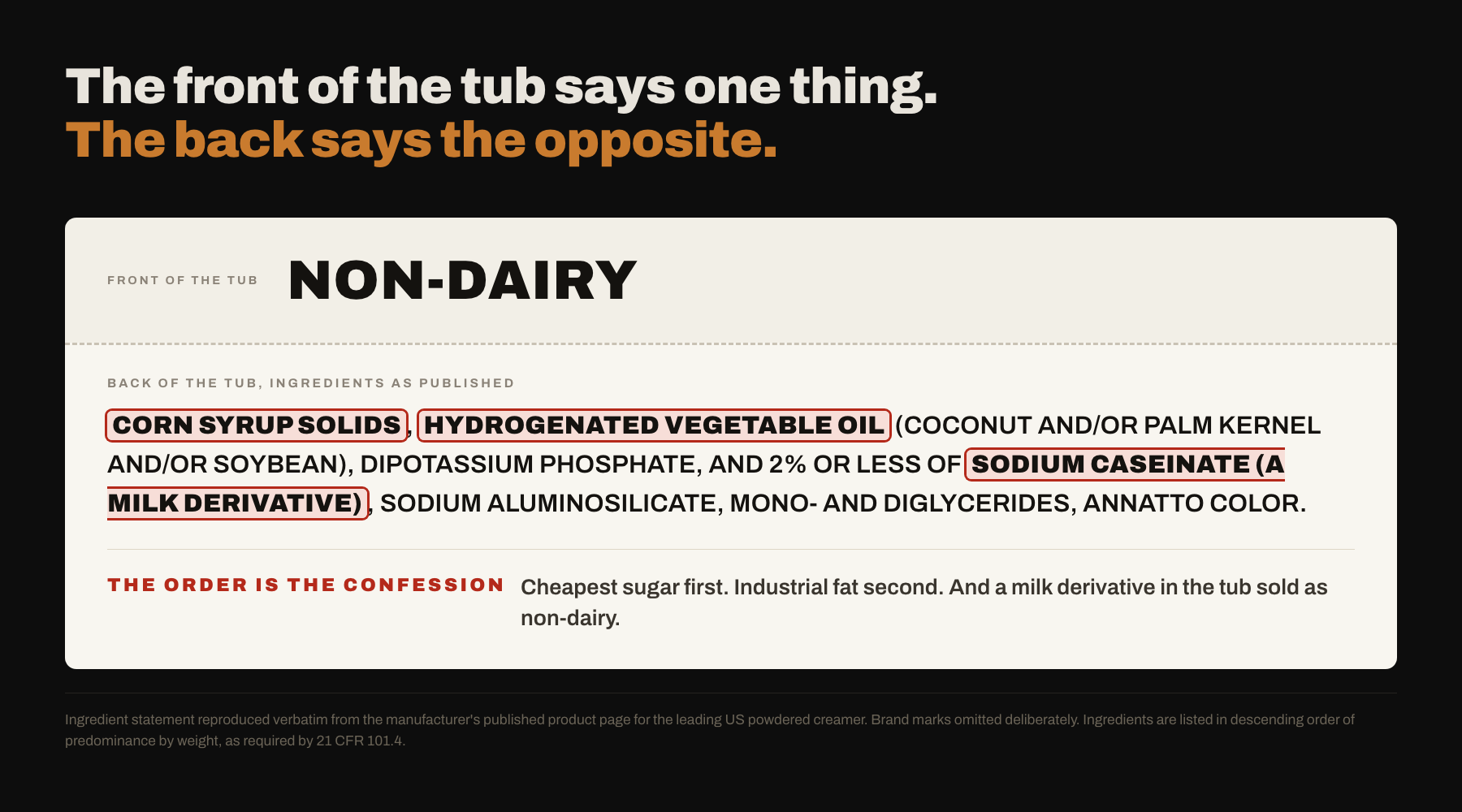
The order is the confession. Cheapest sugar first. Industrial fat second. Then a word on the front that contradicts the line on the back, printed big enough that nobody turns the tub around.
Those are the same things that are in the cereal, the bar, the bread and the yoghurt. The last honest thing on your table now carries the box's ingredients, the box's margin and the box's lie.
The cup was not an oversight they finally noticed. It was the last thing on the table that still belonged to you. Everything beside it had already been taken apart and handed back with a health claim on the front, and once there was nothing left beside the cup, they went into the cup.
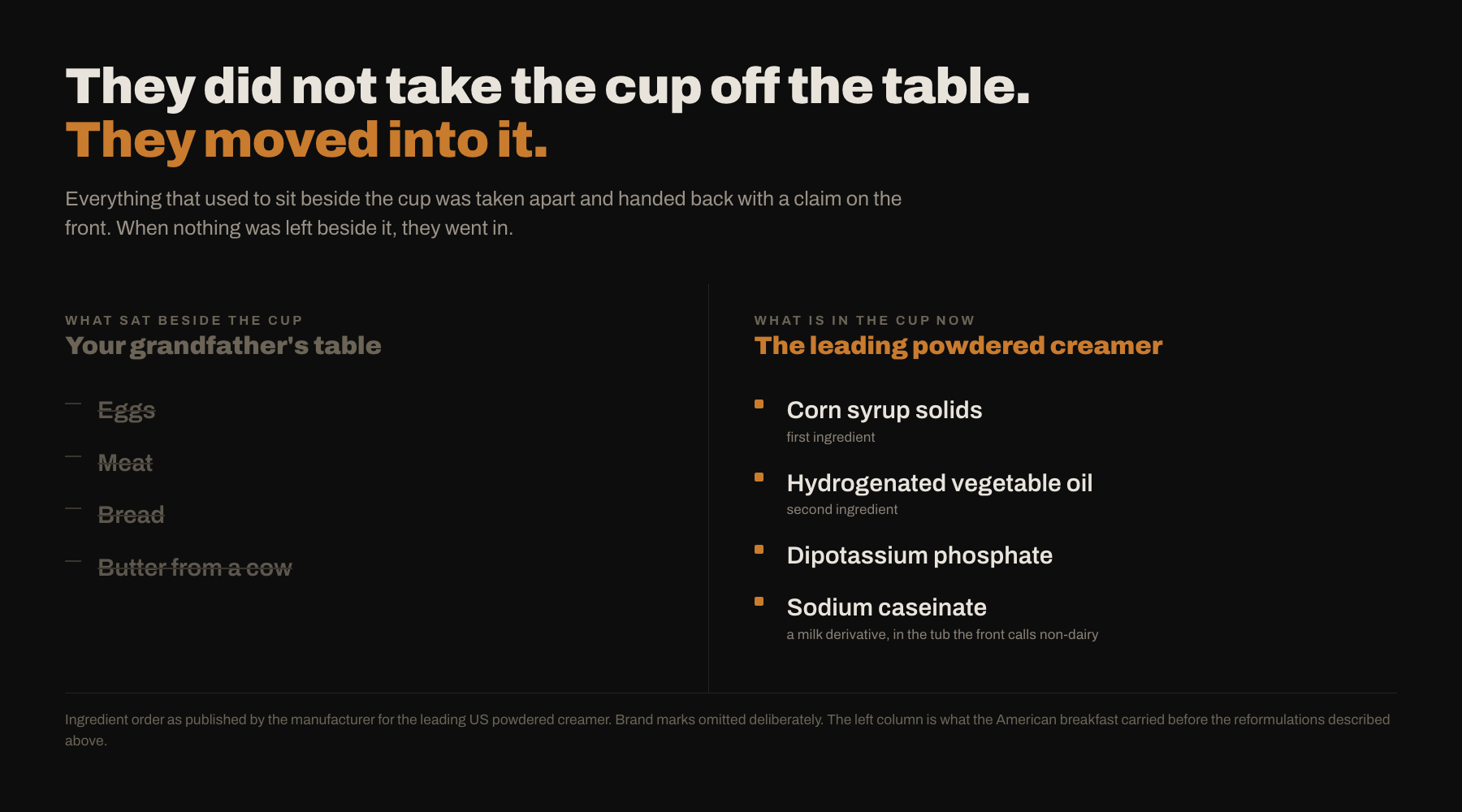
There is no version of this where they stop. Anything you hold onto that costs them a sale gets studied, copied, cheapened and sold back to you. The shelf does not leave survivors standing. It goes looking for them.
Nobody had to plan it. A weak man is easier to control either way.
If you want to see what the new federal guideline actually asks of you before seven in the morning, build it yourself here. Tap what you would really eat and watch the counter. Most people stop around eleven grams.

What we need you to do
Moved up, from below the two paragraphs that follow
Before that, two questions, and the answers are genuinely shaping what we build:
- What is physically on your counter at 6:40 tomorrow morning? Not what you mean to have. Not what you manage on a good week. What is actually there when the alarm goes
- How old were you when you first noticed you were flat by ten in the morning? The age you were when a normal morning stopped getting you to lunch without a second coffee
No definition protects you yet. It is on a desk in Washington while the people who sell you eighty percent of your food argue it down to something they can live with. Until it lands you are your own regulator, and no label is going to volunteer what was taken out of your kitchen.
In the coming days I will show you what we found when we looked at what that first hour actually needs. I am not going to describe it yet, because it is not finished, and I would rather show you a thing than promise you one.
Drop it in the comments. I am reading every one, and we are compiling them. The NMN fight proved something about this list: when enough of you put it on the record, the thing gets built properly.
Then keep an eye on your inbox. What I show you next changes what you think that first hour is for.
To your health,
Antonio
CEO, Black Forest Supplements

These statements have not been evaluated by the Food and Drug Administration. This article is for educational purposes and is not medical advice.
One thing to confirm before this publishes
Sources, and the line each one is allowed to carry
| Claim in the piece | Source | |
|---|---|---|
| "captures 80 percent of the nation's food supply", "fundamentally flawed"; definition at OMB Aug 10 | Consumer Brands Association RFI comment, via Food Safety Magazine, Aug 2026 | quoted, attributed |
| 57.9% of calories; nearly nine in ten grams of added sugar | Martínez Steele et al., BMJ Open 2016 (NHANES 2009–10) | peer-reviewed |
| 56g "for decades" → 84–112g on Jan 7 | Dietary Guidelines for Americans 2025–2030, via FoodNavigator | no year-count printed |
| 1967 NEJM review commissioned and paid for by the Sugar Research Foundation | Kearns, Schmidt & Glantz, JAMA Internal Medicine 2016, from the industry's internal documents | peer-reviewed |
| Hegsted advised the 1977 Dietary Goals and largely wrote the 1980 Guidelines | Senate Select Committee on Nutrition and Human Needs, 1977; USDA/HHS 1980 | verify wording |
| 9 of the 20 advisory committee members with industry ties | U.S. Right to Know, Full Disclosure: Assessing Conflicts of Interest of the 2025 Dietary Guidelines Advisory Committee, 2023 | named report |
| 46.4% of named Food & Beverage federal lobbyists are former government; 345 lobbyists | OpenSecrets, Food & Beverage lobbying profile, Lobbyist Footprint, year 2026 | public dataset |
| Grains and fats cheapest energy; protein highest price | Drewnowski, AJCN 2010 | peer-reviewed |
| Vegetable oil 0.7 → 14.7 kg/person/yr, 1909–1999 | Blasbalg et al., AJCN 2011, via Naughton et al., Healthcare 2017 | peer-reviewed |
| "about 40 grams a day", "half a bottle" vs "eleven" | Arithmetic on the figure above, not a separate claim. 14.7 kg ÷ 365 = 40.3 g/day. At 0.92 kg/L that is 16 L, or 11.3 bottles of 48 fl oz; 0.7 kg is 0.54 of one | shown working |
| Ingredients listed in descending order of predominance by weight | 21 CFR 101.4, FDA food labelling regulation | regulation |
| Creamer ingredient order: corn syrup solids, hydrogenated vegetable oil, sodium caseinate under 2%, front labelled non-dairy | Nestlé's own product page, Coffee mate Original Powder. Reproduced verbatim; brand not named in the article and no brand marks in the image | first-party |
| Big Mac contains 34 g of total fat | Read off McDonald's own US product page: 580 Cal, 34 g total fat (43% DV), 11 g saturated, 1 g trans, 25 g protein. Their figure, not a database's | first-party, confirmed at source |
| 66% drank coffee in the past day, more than bottled water | NCA National Coffee Data Trends, Spring 2026 | past-day phrasing only |
| Muscle leaves on a schedule; least protein loses fastest | Carried from the Sep 17 guide, deliberately without numbers | no figure printed |
Outbound links, and what each one is for
| running-on-fumes | Placed at the end of Act 7, where the reader has just felt the cost and wants the receipts. Framed as free with nothing to buy, which is true |
| 303030 | Placed at the end of Act 8, as a self-test rather than a read. "Tap what you would really eat and watch the counter" sends them to the calculator, which proves the argument on their own behaviour |
Gates honoured
| Product, brand or ingredient named | None. Coffee appears only as the reader's existing behaviour |
| Linoleic acid percentage | Not printed. The +136% figure did not match the primary paper |
| GRAS loophole | Out. Standing house decision, self-implicating |
| Pyramid-in-every-classroom | Not retold. Sep 17 spent it |
| 3–5% per decade, the 40% figure, grip strength | Not repeated. Act 7 carries one line and no numbers; the guide link does that work instead |
| NCA phrasing | "drank coffee in the past day". Never "before anything else" or "every single day" |
| Breakfast-shaming | None. The reader is exonerated in Act 2 and never blamed after it |
| Drug names | None. |
| Villain | The industry, its lobby and the people it paid. Never "we", never the reader. No consumer brands named; the actors named are historical and documented |
| Em-dashes | Zero. |